Layered image and video (8th of October 2013)
Click on the arrow in the window above to start streaming from YouTube. The video illustrates a very simple application of
>> Chroma key technique, known also as green screen or blue screen
technique. Digital tools for video processing allow one to easily cut out the (green) pixels of the background (the image below), and to
replace them with some other image.
You most certainly realize that the visual information you want to preserve must be free of colors similar to that of the background, which
you want to cut out, otherwise you will get "holes" in these places - that is why the chroma key is slightly tricky for non-professional
use, as it requires at least fairly uniform lighting (mostly for elimination of shadows on the background, but also for unwanted diffuse
scattering of light i.e. greenish light reflected from the background to the object in the first plan).
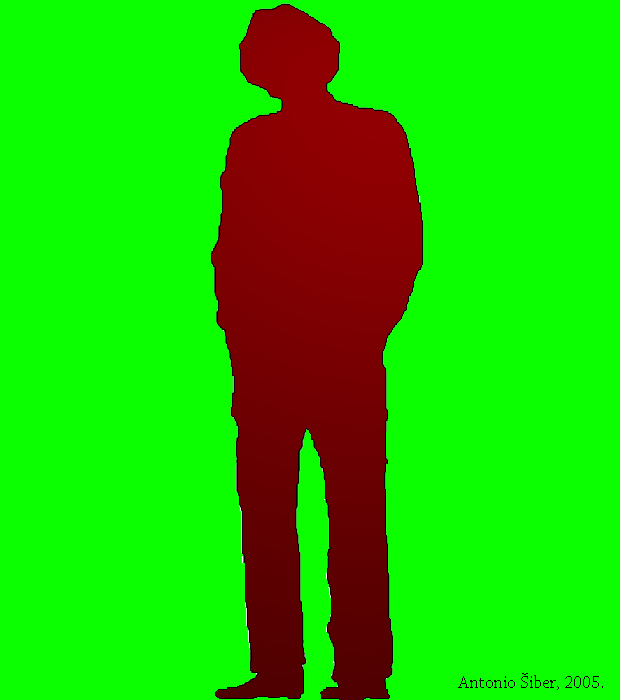
In the simplest application of chroma keying, the green pixels are replaced by the background, i.e. the recorded information which is
preserved after cutting out the green pixels is always "in front" of the background, "closer" to the viewer.
But the whole procedure of chroma keying can be repeated in several steps so that the video can be assembled in layers, by adding the
layers "below" and "above" some chroma-keyed video layer. The idea is very similar to
>> layering, well known in the context of Adobe (and all other)
applications for making and processing (static) image.
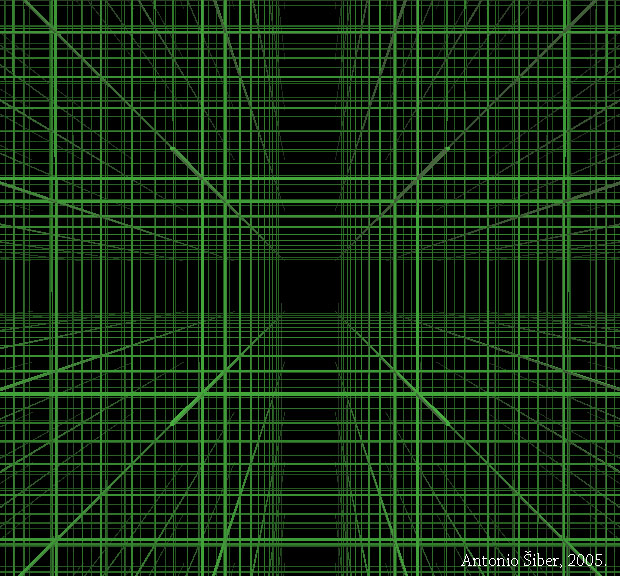
On the example of the video shown, "below" the recorded video, I inserted a part of the network "in front" of the walker (i.e. farther away
from the observer, see the image below) ...
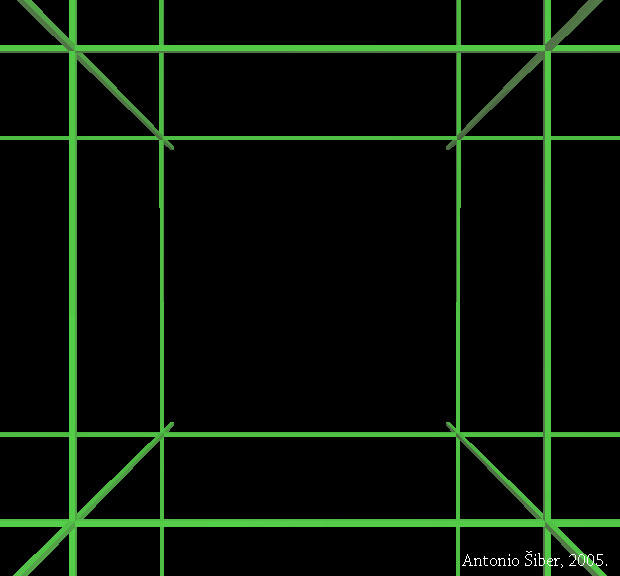
... and "above" the recorded video (i.e. closer to the observer, see the image below) I inserted the part of the network "behind" the walker ...
... so that, in the layered combination, I obtained something resembling the image below. Of course, to produce the video, it is necessary for the parts of the network in front of and behind the walker to be dynamic so to create the illusion of walking.

A significant technological improvement of chroma key effect was achieved by >> Petro Vlahos who died in February this year. I used chroma keying many times while I was making my movie >> Spheres within spheres and in several different ways.
| << Unreality | After a true love >> |
Last updated on 8th of October 2013.