Japanese anemone, 8th of September 2014.
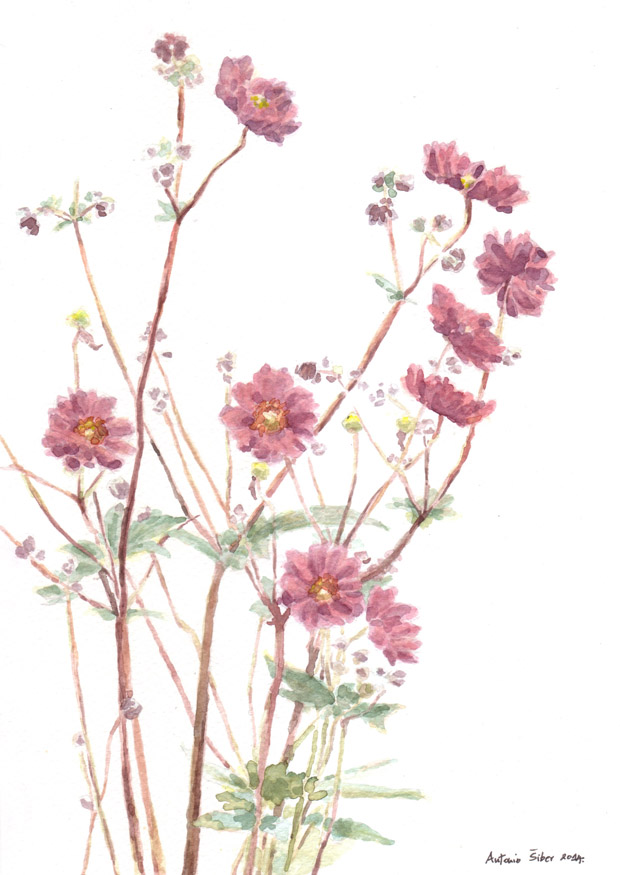
Watercolor, 19 cm x 28 cm
Japanese anemone (above) is a flower which, as its name says, originates from Japan.
Japanese flora and fauna became known in Europe thanks to physicians-naturalists who pretended to be Dutch in Japan, though most of them
weren't. Japan, namely, after 30-year-long terror, exiled all the Christian missionaries (mostly Portuguese Jesuits and Spanish Franciscans) and
imposed the ban on docking in its harbors to all the ships except those from China and Netherlands (though only in Nagasaki and Hirado ports).
This isolationist policy (the so called 'sakoku' or 'the see restriction') continued all until year 1855 and it enabled a monopolistic
position to Dutch East India Company. That is why all the employees of the company stated they were Dutch upon coming to Japan.
Such was the case with Bavarian >> Philipp Franz von Siebold
(1796-1866) who came in Japan as a physician in Dutch trading post Dejima in Nagasaki - Dejima was in fact a miniature artificial island,
sized about 120m x 75m and used by Dutch to organize their trading activities [1]. Von Siebold was impressed by Japan, especially by its
flora and fauna which he documented during his stay there, and also brought many samples and seeds to Europe - some of the plants which came
with him became very successful in Europe and are considered as weed today.
For the documentation of Japanese animals and plants, Siebold needed skillful illustrators, and Japanese painters didn't quite satisfy the
requests of European scientific illustration of the time. That is why Siebold organized arrival of two illustrators from Batavia (Jakarta),
Heinrich Burger and Karla Hubert de Villaneuve [1] who produced some of the illustration he requested, but also probably taught local
talented painter Kawahara Keiga (1786-1862?) [2] the techniques of European botanical illustration. Keiga later made watercolor illustration
for Siebold, but they were still often not suited to European taste. European illustrators hired by Siebold upon his return to Europe
reworked and redesigned Keiga's illustrations [1] in the course of preparing them for lithographic printing, which often resulted in a loss
of simple elegance typical for eastern approach to painting that Keiga strived to achieve. It appears that Siebold himself also cut out pieces
of Kawahara's illustrations and "rearranged" them according to European botanical taste [3].
The illustration of Japanese anemone below is from the book 'Flora Japonica' which Siebold published together with
>> Joseph Gerhard Zuccarini (1797 - 1848), but that huge and multi-volume
undertaking was brought to an end only after their death, in year 1870 by
>> F. A. W. Miquel (1811–1871), the director of Rijksherbarium
(national herbarium) in Leiden.

A detailed insight in the illustration / lithograph reveals that the lower left corner contains the name of S. Minsinger, a the lower right of
W. Siegrist. Siegrist is almost certainly the author of the litograph, and Minsinger most likely reworked Keiga's original illustration - such was
apparently the case in many of the illustrations from "Flora Japonica" [1]. Keiga's name is not mentioned, even in the illustrations which are
known for certain to be directly based on his original work (e.g. Wisteria floribunda [1]).
Though Sigrist's and Minsinger's work illustrates well the Japanese anemone, its "elegance" and "posture" is lost in their representation, especially with
respect to the specific geometry of the stem which is not so "neatly" curved as their variant suggests. Additionally, mutual
relation of the anemone flowers which grow from the same root is not seen clearly in their variant - in my Japanese anemone from Croatian
Zagorje :) this is particularly emphasized. I haven't been able to get the proper color of the anemone flowers from the watercolors I have - the color
of the living flower is much more intense than the one I got. Siegrist and Minsinger also didn't succeed in reproducing the color appropriately.
Concerning Siebold, it should also be said that he was one of the first japanologists. In addition to documenting Japanese flora and fauna, he also
made detailed and systematic records of Japanese religions, philosophies, customs, geography, mathematics, music, tea ceremony, art of war ... [4,5].
Keiga's illustrations of Japanese landscapes and cities appear also in Siebold's ethnographic publications. Siebold was during his stay in Japan in
a relationship (perhaps also married?) with a Japanese woman, and had a daughter >> Kusumoto Ine
(1827-1903) who was the first Japanese female physician who practiced European medicine (mostly gynecology). Siebold didn't have time to teach her
the skill as he was expelled from Japan in 1829 - she was taught by his Japanese students. He was expelled from Japan and accused of being the Russian
spy as he acquired maps of Japanese territories, which was, by the rules of sakoku policy strictly forbidden for foreigners - he returned to
Japan to stay there for two years only thirty years later. Siebold also (semi-successfully) introduced the vaccination against smallpox in Japan [4] and
successfully applied other European medicinal procedures and techniques, such as the cataract operation. It is perhaps most important that he taught
those procedures to his Japanese students who gradually spread them throughout Japan.
The significance of Siebold's work in establishing European-Japanese relations is well recognized today and it was celebrated in year 1996 by a
postal stamp that was simultaneously published in Germany (below) and Japan to mark 200 years since his birth.

And Keiga, he published only 56 of his illustrations (in Japan) during his lifetime [3]. But many of them were published in year 1993 in
a book entitled "Siebold's florilegium of Japanese plants" - it is Siebold's botanical collection acquired (and published) by Russian academy
of science.
In order to get some insight in original work of Kawahara Keiga, below I show his illustration of a plant called Raphanus sativus.
One can see an unusual combination of European botanical illustration [6] and "Zen" simplicity and elegance characteristic of traditional
Japanese painting.
This post is an introduction to a new category of posts which I entitled "botanical illustration" (see >> archived
worlds where I also updated >> the post on orchid). The posts will, in addition to my illustrations of
plants, contain also bits of botanical history, especially related to botanical illustration.

LITERATURE:
[1] James A. Compton and H. Walter Lack, The discovery, naming and typification of Wisteria floribunda and W. brachybotrys
(Fabaceae) with notes on associated names, Willdenowia 42, 219-240 (2012).
[2] Christina M. Spiker, Japanese Giant Salamander: Otherworldly Nature, August 2013, personal blog, cmspiker.me, visited on 09/2014.
[3] Kate Thomson, Siebold's botanical illustrations: Mastering the fine art of science, The Japan Times on Sunday, Jul 3 (2002).
[4] Alexander Kast, Contributions to German-Japanese medical relations I, Acta med-hist Adriat 2, 61-65 (2002).
[5] Yu-Ying Brown, The von Siebold Collection from Tokugawa, Japan.
[6] Marion Ruff Sheehan, Illustrating Plants in The Guild Handbook of Scientific Illustration ed E.R.S. Hodges, Wiley, 2nd
edition (2003).
| << Cyanosis | Water vedute: Ugljan >> |
Last updated on 8th of September 2014.