Cyanosis, 1st of September 2014.

Here are two words, rarely used in general population, which I heard quite often in the last month:
- cyanosis: (pathology) A blue discolouration of the skin due to the circulation of blood low in oxygen.
- cyanotic: (pathology) Afflicted with cyanosis.
(as defined in >> Wiktionary)
Both words have in their root a notion of (blue) color (greek kyanos) for which we don't have a proper name in Croatian: cyan. Wiktionary says:
- cyan: A colour between blue and green in the visible spectrum; the complementary colour of red; the colour obtained by subtracting red from white light.
If we try to write down the "subtraction" in a most primitive way in RBG scheme, "color" white would be white=RGB(1,1,1), and
subtraction of red would then give cyan=RGB(0,1,1), i.e. a color which has equal components of green and blue and does not have a
component of red (on a scale of 255 levels of color, the ones (1) in RGB notation can be replaced by 255, so the cyan would be RGB(0,255,255) or
#00FFFF in HEX code). This color is shown in the image below.

By sampling web sources it is possible to approximately estimate the span of the color interval which may be called cyan - perhaps the
right place to start is >> Wikipedia's entry on cyan. In some sources one can find a quite rigid definition of
cyan as the part of the visible spectrum with wavelengths between 490 nm and 520 nm - one should, of course, be very cautious in relating wavelengths of
the spectrum to colors because the relation is extremely complicated and involved.
Thinking of all these colors I got an impression that I would
definitely call some of them blue(s), e.g. these shown below ...
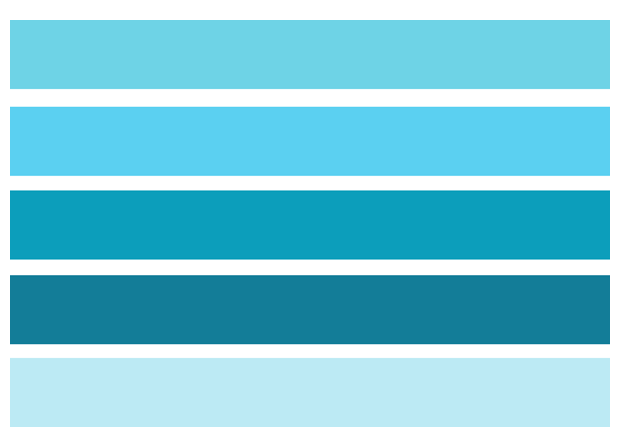
... while I would be doubtful in the part of the interval, but I'd still be inclined to consider these colors as belonging to the concept of green (below):

The word cyan as a label for color is used in English for a relatively short time, apparently only since the year 1879, and it is not considered
as the basic term for color in English. What exactly is the basic term for color is, of course, again an interesting question - for example,
do we consider svijetlo-plavo (light-blue) as the basic term for color in Croatian or we consider plavo (blue) as the
basic term and svijetlo-plavo (light-blue) only as a variant, a tone, shade of blue. In this context it is interesting that Russian has two basic
terms for blue color: goluboy, which would cover the interval of light-blue (svijetlo-plavo) in Croatian, and sinyiy which
would in Croatian cover the interval of darker blue. The whole story, which started from a medical concept :), becomes thus interesting from linguistic,
anthropologic, and cognitive aspect:
1. What in physical reality leads to a concept and a word for color in a language and how wide is the interval of colors
belonging to be the same color concept and why? Where are the borders between different concepts of colors and why?
2. Are there differences between speakers of different languages in cognition and naming of color and what is their source?
Of course, I am not the first to ask these questions, the researchers deal with them for at least seventy years. There is an 'orthodox' theory of
constructivism (Construction of Reality :) ) which essentially states that our minds impose the structure to sensations. A related
theory is >> lingustic relativism whose proponents (so
called Whorfianists according to >> Benjamin Lee Whorf who played
an important role in the foundation of the theory) claim that the
language we speak influences the way we think and sense, and that the differences in grammar and vocabulary, and in the names of colors and
the color intervals understood by these names, reflect the difference in cognition. Somewhat similar idea appears also in
>> Problem of the observer, in the dialog between the professor and Egghead:
- It can't be that you needed the language at all? Why use language next to mathematics?
- It is not exactly that easy. The problem is that none of the "final" conclusions could be stated, and this means that they couldn't be thought of in a completely consistent fashion. More exactly, they weren't conclusions at all, they were paradoxes. Which can not even be stated. Cognitive dissonances.
As there are fierce proponents of constructivism or whorfianism (Sapir-Whorf hypothesis on linguistic relativism), there are also proponents
of opposite hypothesis who claim that we all comprehend the world in similar fashion and that its physical reality manifests equally in
minds of all people, irrespectively of the different languages they speak and cultures they originate from. OK, now you see that the problems
start to depart from the sphere of hard science and enter the terrain in which it is difficult to give some concrete and hard arguments.
But, there were experimental attempts to "quantify" the role of language and culture in the perception of color.
For example, in the work of Debi Roberson and collaborators [1], an experiment is described in which the test subjects from different
cultures and speakers of different languages were offered colored tiles from the table / array of colors shown in the image below:

Even earlier (in 1972) a somewhat similar experiment was conducted by >> Eleanor Rosch Heider,
and what is particularly interesting is that the researchers offered color tiles to the members of "primitive" cultures with stone age
technologies - Rosh investigated members of >> Dani people from west New Guinea, and
Roberson and coworkers investigated speakers of Berinmo language, also from Papua New Guinea (there is a wealth of Papuan languages as
the >> Wikipedia article suggests). In the experiment, the test subjects were asked to
effectively divide the table of colors in "sets" i.e. they were offered colored tiles from the array and asked to name them. All the colors that
were named in the same way were later denoted as a set, a polygon on a table of colors (whose technical name is Munsell's array of 160 colors [2]).
Of course, it is particularly interesting to compare statistical analyses of choices / answers of English speakers and speakers from "primitive" cultures.
The analysis of choices of English speakers (constructed according to [1]) is shown in the image below:
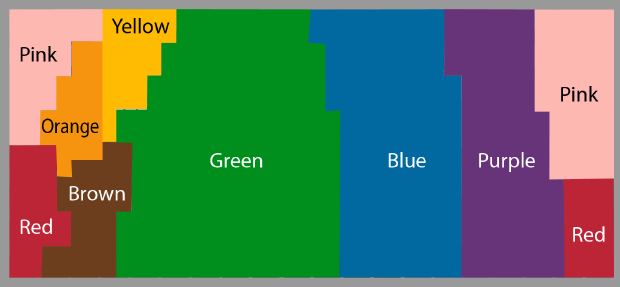
English speakers divided the Munsell array in 8 color regions: green, blue, purple, red, pink, orange, yellow, and brown. The test subjects were also asked
which of all colors they called e.g. green is the most representative for all greens, and the color territories in the image above were
colored with these colors (i.e. the ones that are the most representative of the color regions / territories according to test subjects) - this is my
reconstruction based on the analysis of Munsell's arrays and interpretation of results in [2] and [4] which were originally represented in black and white.
I, as a Croatian speaker, would do more or less the same as English speakers, and the colors that I would chose as the most representative ones would
also correspond to their most frequent choice. Even the border between the colors I call blue (plavo) and green (zeleno) would be at about the
same place - this is statistically proven for speakers of Russian and English [3] who separate the blues and greens at about the same places / colors.
These arguments speaks of a certain universality in the cognition of color, irrespective of the linguistic and cultural preconditioning. Yet,
the division of Munsell's array by the speakers of Berin(o)mo from Papua New Guinea (below, constructed according to [1]) makes one think again.

For the start, the Berinmo speakers see smaller number of color regions, only 5 of them, and what is even more interesting is the obvious
division of the color table in regions of light / bright (the "color" they call wap) and dark (the "color" they call kel) - bright
colors are at the top of Munsell's array and the dark ones at the bottom, the same as wap and kel. This might mean that the
colors in Bernimo are not discriminated between when they are very bright or very dark and that, in these conditions, they all belong to
the same category. Wor approximately corresponds to our yellow and orange together and it also covers a smaller part of the region of
our (yellow-)green, which is not surprising and points to a certain universality.
Mehi obviously corresponds to our red, but it also covers quite a range of purple and brown, which again suggests universality. It is
interesting that the Berinmo speakers do not discriminate between green and blue and they call the whole territory of greens and blues
nol. The most representative nol color is, interestingly, a darker tone of green, quite close to the border with blue (perhaps
it could pass as a dark tone of cyan).
The Munsell table was somewhat similarly divided by the members of >> Himba people, speakers
of Himba language (a dialect of >> Herero language) from Namibia (below, constructed
according to [4]).

Vapa corresponds very well to wap from Berinmo (interestingly, the names are also similar!) and it obviously denotes light, while
zoozu excellently corresponds to kel and it denotes darkness or dark color tones. Dumbu is again both yellow and orange,
but in Himba language it also includes quite a portion of our green - the most representative dumbu is a bit lighter and a bit
"greener" from the most representative wor. Burou is again both green and blue, somewhat more towards blue than nol from
Berinmo, and the typical representative is from the border between our blue and green, therefore definitely a variant of cyan.
Serandu approximately corresponds to mehi color from Berinmo, and the most representative serandu is somewhat more purple
than the most representative mehi.
In the end, what should one conclude from these experiments? Whorfianists typically interpret the results in the context of non-universality of
color categories. Yet, I would interpret them differently. There are definitely elements of universality in color detection, especially in borders
between color categories. Separation of blue and green is somewhat problematic and it does not exist in Berinmo and Himba, but the concept of
red (+ purple) is obviously preserved and it corresponds to our concept. The concept of yellow (+ orange) is also preserved, but the Himba speakers
extend this category with a bit of (our) green. Perhaps the most interesting feature is that the Himba and the Berinmo speakers "do not bother" to
differentiate between very dark or very light colors and use special concepts for these parts of the Munsell array (top and bottom), which is
not really surprising.
It should, of course, be added that the cognition and understanding of colors depends also on what one does and whether one deals with colors every
day. For a painter (and there were no painters among the test subjects) the huge territories of color, either in English or Berinmo are completely
purposeless. For a painter, it is completely useless to call all these different colors with the same name, and they thus often use their
"dictionaries" of color in which colors and patterns are called e.g. "old copper", "dark honey spread over a thick butter", "white borders on
a Payne's gray sky" or "very blue green, perhaps a mixture of viridian and cobalt blue".
Those who want to continue this amateur anthropological-linguistic-cognitive-physical, but also painting quest can start with
investigaton of >> publications by
Debi Roberson, and then they should search for the publications written by her opponents.
LITERATURE:
[1] D. Roberson, I. Davies, J. Davidoff, Color categories are not universal: replications and new evidence from a stone-age culture,
Journal of Experimental Psychology: General 129 (3), 369 (2000)
[2] E.R. Landa, M.D. Fairchild, Charting Color from the Eye of the Beholder, American Scientist 93, 436-443 (2005).
[3] I.R.L. Davies, G.G. Corbett, A cross-cultural study of colour grouping: Evidence for weak linguistic relativity, British Journal of
Psychology 88, 493-517 (1997)
[4] D. Roberson, J. Davidoff, I.R.L. Davies, L.R. Shapiro, Color categories: Evidence for the cultural relativity hypothesis,
Cognitive psychology 50 (4), 378-411 (2005)
| << Cat Tiger and dog Fidel | Japanese anemone >> |
Last updated on 1st of September 2014.