Tiling physicist, 27th of March 2011.
To finish the study of engineering physics at PMF (natural sciences and mathematics faculty) in Zagreb is by no means
easy. I remember the second semester of the fourth year of study (1995/1996) when I completely lost interest in
physics. I already had enough of it all, and the professors didn't manage to preserve nor to lighten up my enthusiasm.
It is not that anybody made a particular effort about that... But, that is how it always is. I guess. You have to
make important things happen yourself, nobody will do anything good before you start it. Probably not even then,
but once you get on your way, everything starts to look easier.
That is why I finished my study by night. Sleeping during the daytime and learning in the nightime when everyone at
home was sound asleep, nothing could be heard from the outside except for some nightly birdie. Light in my room,
walking with a cig in my mouth. Man. How many I have smoked then... At night, with the physics of elementary
particles and solid state physics. And then I crush down sometime at seven in the morning in the repugnant
atmosphere full of smoke and I get asleep. Until the afternoon. And then again.
But it helped. I got my diploma in August in 1996, and I got my job at the Institute of physics in February 1997.
One sees beautiful things in that study. Goldstein and classical mechanics. Jackson and classical electrodynamics.
Schiff and Sakurai and quantum physics. Einstein's derivation of Planck's formula and statistical mechanics. A lot
of knowledge one needs to adopt. But it is not only about the knowledge. The number of facts that one needs to
remember while studying engineering physics is probably far less than in some other studies. The changes of
perspective are what it is all about. It is about learning to look at the world from different positions. To
dance around your own ignorance and constantly feed a thought that you are perhaps quite stupid and that you
should start looking at it in a different way. It is not a small task. The true natural science is completely
free and non-dogmatic and it needs a free and different thinker. It is important to view the problem as it has
never been viewed before. Especially if one wants to be original. And that is not easy...
After all you realize that you don't have someone to talk to about these things. I have only four or five people, still
living, luckily for me, two of them outside Croatia, to whom I can talk to about it all. I wonder then why I write all this,
but OK ... Even my colleagues physicists often cannot dig these important aspects of nature of scientific activity.
So, how can one expect to be understood by someone how didn't go through the required study?
And that someone cannot dig you, really. It cannot be helped. But sometimes, only sometimes, people understand that
in that weird education of yours and completely misplaced interests, there is something that is perhaps, in some
asymptotic approximation, useful. Say, tiles. I mean, to arrange the tiles so to cover the path, terrace or whatever...
And that is how this post begins. A physicist who arranges the tiles. Tiling physicist. It is good, it could have been worse.
The first idea of my parents was that the large tiles are reddish ("terracotta") squares, and the small ones are the
white squares whose side is three times shorter. So there are few "designs" that I produced in half an hour (below).
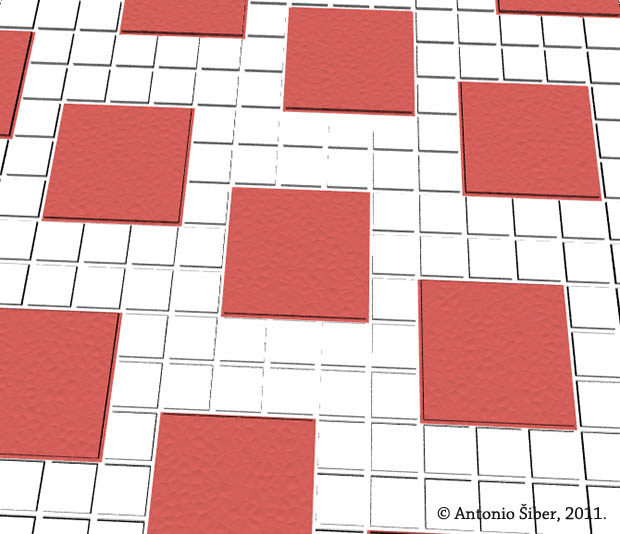
On the one shown above, I wanted to be "unobviously" periodic. Perhaps it would work as a design were the tiles small enough.
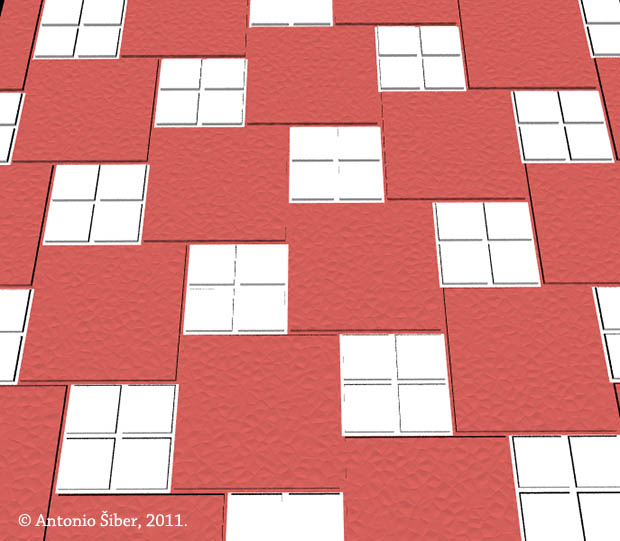
This simpler and more obvious design (above) is more pleasing to the eye. It creates effective lines that are non-parallel to the sides of the tiles.

And then again unnecessary insisting on an "un-obvious" periodicity (above). Not pleasing to the eye.

A lot simpler (above), yet relatively pleasing to the eye. Only it is quite red...
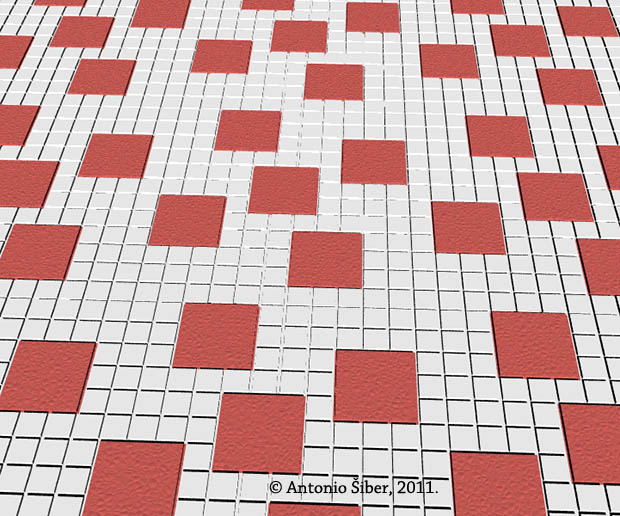
A complicated periodicity again (above). I just could not make it effective.

And then it turned out that tiles are different after all, i.e. that there are large white ones, small white ones, and small red ones. Can one combine that? Sure...

A simpler and much more predictable, but a dull design is shown below. I think one can see this one relatively often.
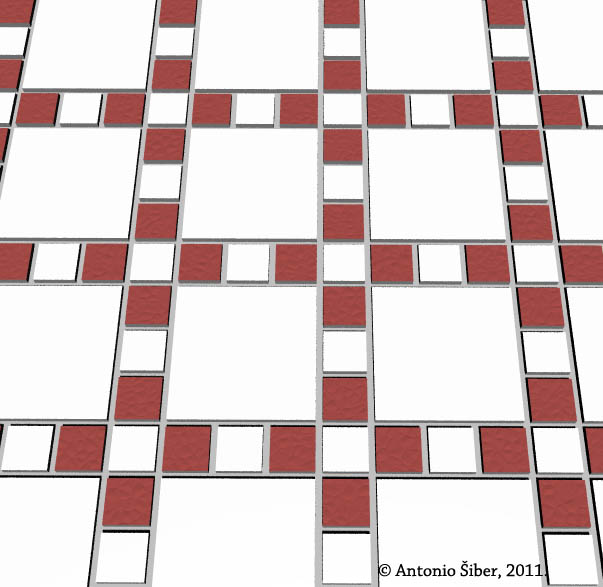
And the one below caught their attention. An instant favorite. To me it is somehow simple. In fact, I wasn't pleased with neither one that I proposed. A day without inspiration. I don't like deadlines.
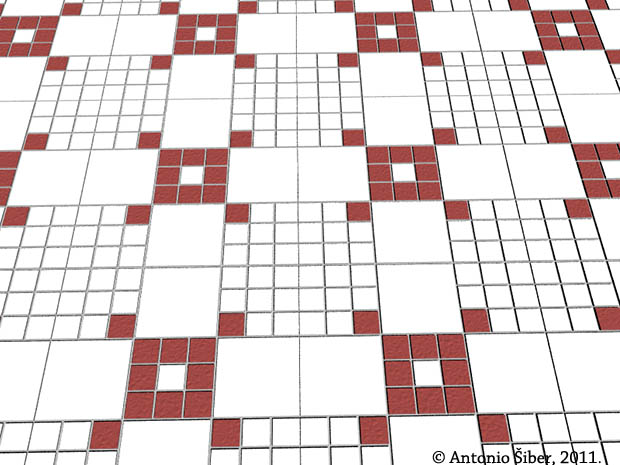
Perhaps the two below are a bit better.

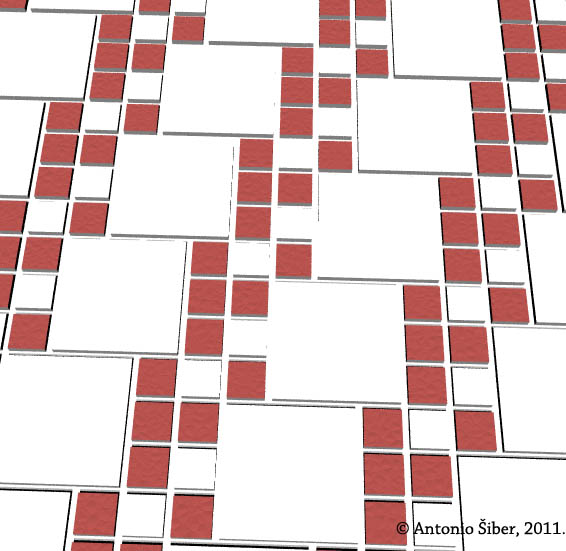
Finally, after my parents visited the store that sells the tiles, I found out: a) that large tiles are in fact gray b) that there are three types of small tiles, gray, white and red. So here is the design that combines it all (below).

A final piece of information was that the large and small grey tiles are at a special discount so I proposed the designs that account for this fact (below).

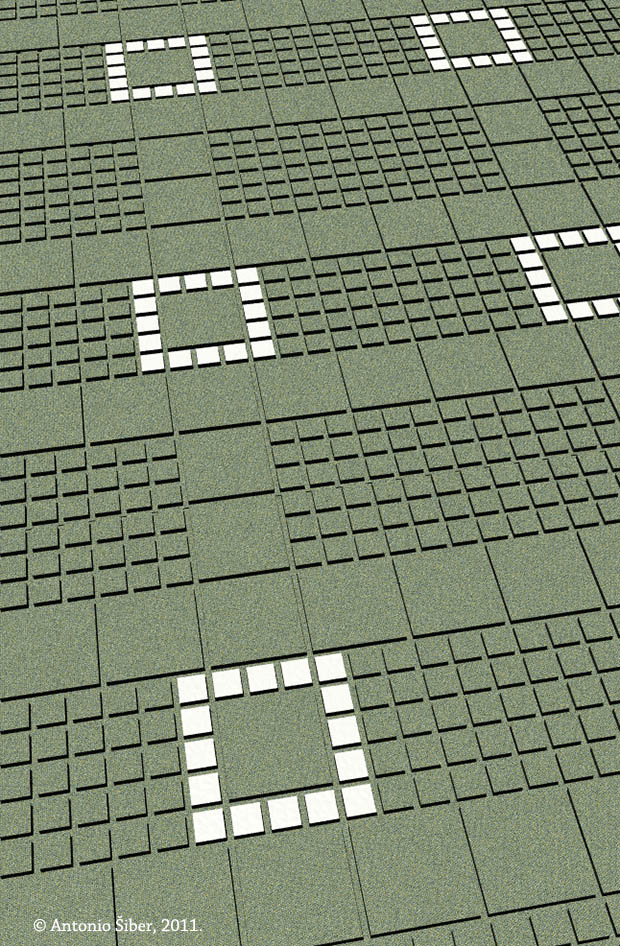
The end result, that my parents accepted is shown in the image that opened this post. Nothing
special, yet it fits nicely in some other elements of design in the space where the tiled path is positioned.
Another element of the physicist "magic" was that I with ease calculated how many of each type of tiles need to
be ordered. It is not that an average high-school kid couldn't do it... I hope that I'll soon refresh this post
with a photo of a "real thing", i.e. an assembled path.
UPDATE: (2nd of April 2011) Below is the photograph of "the real thing". It is interesting that small and large grey tiles are not of the same shade of grey, but the design still holds well.

| << In God We Trust | In a million years >> |
Last updated on 2nd of April 2011.