Sea cave (O magnum mysterium), August 2009
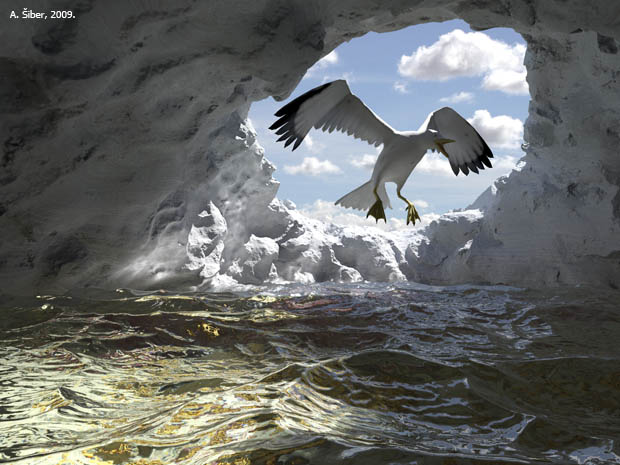
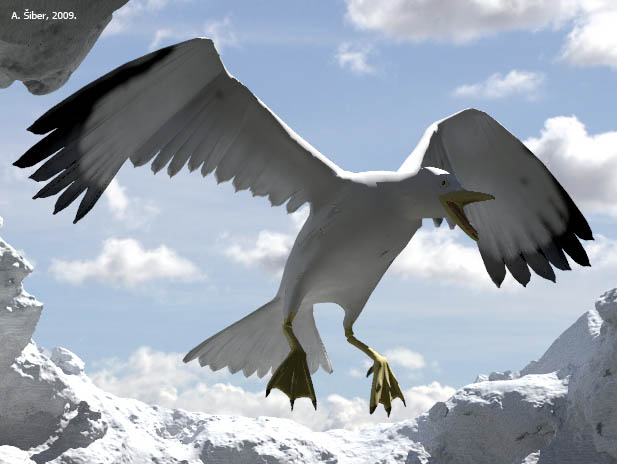
When I made the first version, I thought about two things: a) it's full of pathos, and b) it reminds of religious art (mostly because of the gull that looks as if announcing something with its screaming, and the water is also restless).
Because of the second thought I gave the subtitle to the image, but also due to the secret about what's underneath the water surface (O magnum mysterium... O what a great mystery...). The more I analyzed the image, the less I wanted to change anything (later I did it...) The traces of yellow, green, and red color, especially in the lower left corner of the image, come from the algae and sponges at the cave bottom. The rest of color comes from the dependence of the index of refraction ln the wavelength. Therefore the white color separates in the spectrum - this effect can often be seen near the water, especially is you are an astute observer. For the algae I was inspired and informed by the paper by M. Arko-Pijevac et al, "A submarine cave at the island of Krk" , Nat. Croat. 10, 163 (2001). The cave bottom in my construction of the piece of the world is covered by algae amphiroa (that's where the red-violet tones come from), padina pavonica (brown, grey, white), small green algae (valonia utricularis, ...) and sponge axinella damicornis (yellow tones). I also made codium bursa, but it lookes somehow surreally cyan to me so I didn't use it (although is looks beautiful... maybe some other time).
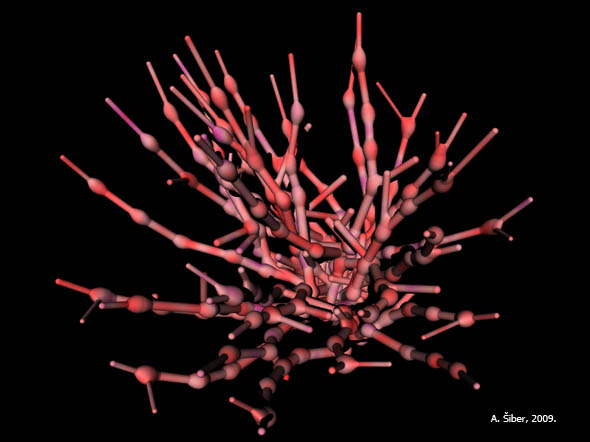
My version of amphiroa (rigida? but more red...)

My version of axinella damicornis

My version of codium bursa
Regarding the fact that we can see the bottom, our eye is hit by the ray that is at least twice refracted on the water surface: the first time on the entry, reflects from the bottom, and refracts again on the exit from the water, continuing its path toward the eye. In any case, Fresnel equations say that the reflection of light that enters the water surface perpendicularly (the angle between the ray and the normal is zero) is only 2-3% (97-98% is thus transmission - that's why one can see the bottom), while the reflection of light parallel to the water surface is 100%. It is interesting that this is approximately true for "real" water from the "real", and not constructed world. In my construction of the world, Fresnel equations are obeyed with regards to sum of transmitted and reflected light being 100%, but the reflection for the normal entry is 20% (instead 2-3%). Modern raytracing software is in fact great optical laboratory. To calculate the refraction and reflection of light through the unsettled mass of water is a complicated business.

This image also contains caustic effects (i.e. structures in the intensity of reflected and refracted light that can be seen on objects). They are most easily seen on the rocks near the cave entry, just above the water surface.
It is too bad that so many nicely modeled objects cannot be seen clearly underneath the water surface, except for some color that they give, but that is why it is a great secret ...
But... Regardless of all, regardless of the fact that our science does not decribe the world by itself, but only our knowledge about it, regardless of the influence of observer and all the subjective elements that are introduced in the description of nature by relativity and quantum mechanics. Regardless of all that, and I can even agree on it ... You still, doubtlessly, believe that there is something we could call an "objective" reality, that there are some laws founding the Universe. Perhaps these laws do not have much in common with our experience of them, yet they must exist? You must believe in it, because, otherwise ... how would you do science? (a passage from Problem promatrača (Problem of the observer), chapter 25, a part of conversation between a student from Slovenia and professor).
| << Cloister | L world >> |
Last updated on 3rd of September 2009