Rabo in Dresden (13th of January 2016)
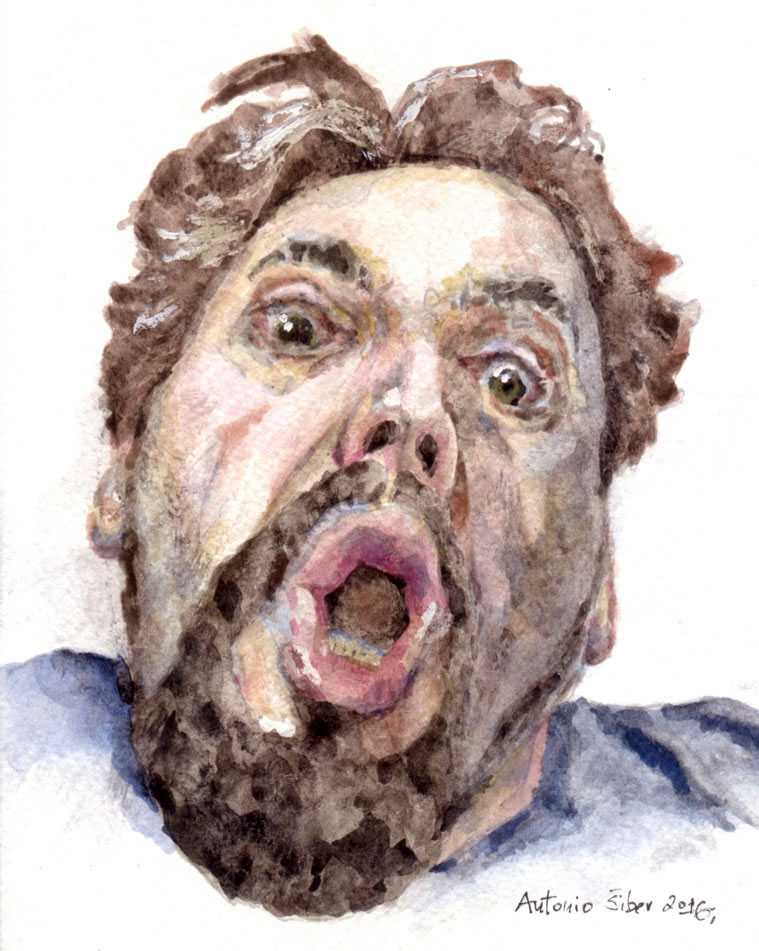
Vonnegut's most famous novel, "Slaughterhouse-Five" has been proclaimed quietistic by some critics. Those wisemen have found in Vonnegut's writing some
sort of "understanding" for horrible slaughter of war and a sense of tragic hopelessness against the human evil which every so often gushes from this civilization
of ours. Of course that something like that can be found in "Slaughterhouse-Five", but the reason for this is not some quietistic philosophy of Vonnegut but
post-traumatic stress disorder which for 24 years prevented him to think anything consistent of Dresden bombing, let alone write something about it. The
main protagonist of the novel, Billy Pilgrim, also suffers from post-traumatic stress disorder, and such a state enables him to communicate with Tralfamadorians,
inhabitants of planet Tralfamador which look like upright toilet plungers, with one green eye on a palm of small hand at the top of the plunger handle.
Tralfamadorians know that the evildoing in Dresden was in a way "necessary" because history for them does not exist as a dynamical activity. Since Tralfamadorians are
four-dimensional beings, all history and all time is available to them and every "moment" can be visited by wish, after learning skills required to "travel through
time" (more precisely, "to unstuck in time", as Vonnegut writes).
Carbonized Dresden is thus always there, nothing can be changed about it nor it could ever have been and by that, indeed, wise critics of Vonnegut are right - Tralfamadorians do sound like quietists created by the tortured minds of Billy Pilgrim and Kurt Vonnegut.
Activism and persistence in attempts to change something are signs of a healthy spirit. But they are also signs of a spirit which didn't have the misfortune to see plenty of entirely absurd deaths and evildoings - that is why it is healthy, unlike Billy's:
Most common figure of speech in Tralfamador is
... and every time someone dies in the novel, and that happens often, Vonnegut also writes: "So it goes."
One should by no means get confused and think that "Slaughterhouse-Five" is some SF novel - that would be entirely wrong. "Slaughterhouse-Five" is
a novel about how people, even two thousand years after Jesus Christ, did not become good, because it seems that there has been a mistake in the way New Testament
was written so that the true message of Jesus, the one about love, did not successfully come through. It is a novel about evil we deposited in the amber of time,
about Dresden which repeats all the time, massacred completely innocent people, children who kill, about pathetic human consciousness which cannot stay healthy and
endure the evil it is emerged into and which it also creates.
Vonnegut of course knew that his fellow citizens will hate him for writing about all that, and especially about what happened in Dresden. And he is not the first one,
no one likes to listen about "our guys" who did evil things. That is how it is in all wars, that is how it was in Vietnam war when Vonnegut published his novel in
1969, and that is how it was in the wars in ex-Yugoslavia. Still, if it wasn't for Vonnegut and the likes of him, war may (to the unknowing ones) look like a noble undertaking -
our boys who defend good (children-crusaders - the subtitle of the novel is "The Children's Crusade") against them, who are embodiment of evil. That is why Vonnegut is
by no means quietist and that's why his role is extremely important.
'But you're not going to write it that way, are you.' This wasn't a question. It was an accusation.
'I-I don't know,' I said.
'Well, I know,' she said. 'You'll pretend you were men instead of babies, and you'll be played in the movies by Frank Sinatra and John Wayne or some of those other glamorous, war-loving, dirty old men. And war will look just wonderful, so we'll have a lot more of them. And they'll be fought by babies...
"Slaughterhouse-Five" is at 29th place of the >> list of banned and challenged classics which was created by the American Library Association. The novel was banned, burned, censored, thrown out of libraries, syllabi and assigned reading lists with the explanation that it is "depraved, immoral, psychotic, vulgar and anti-Christian". I, of course, do not think so. I think that more closer to the truth is the categorization of Modern Library which puts "Slaughterhouse-Five" at number 18 of 100 best novels of XXth century written in English.
The painting above shows Rabo Karabekian, i.e. Billy Pilgrim just at the moment the Tralfamadorians unstuck him in time and picked him up on their spaceship. He asked them:
' That is a very Earthling question to ask, Mr. Pilgrim. Why you? Why us for that matter? Why anything? Because this moment simply is. Have you ever seen bugs trapped in amber?'
'Yes.' Billy in fact, had a paperweight in his office which was a blob of polished amber with three ladybugs embedded in it.
'Well, here we are, Mr. Pilgrim, trapped in the amber of this moment. There is no why.'
Find more posts about Vonnegut's books in >> the archive.
| << Happy New Year 2016 | High blood pressure >> |
Last updated on 13th of January 2016.