Kaleidoscope (26th of January 2010)
Press play in the window above to start streaming from YouTube. Another visualization of my music, but perhaps
more interesting than music is the technique I used to make the video. It is a kind of "virtual kaleidoscope".
Kaleidoscope was invented by David Brewster (I already
wrote about him in the context of stereoscopy, the link is in
Croatian), although I heard somewhere that already Archimedes knew about the principle and made a first
working toy (OK, there are all sorts of legends about Archimedes, so it may not be true). In essence, kaleidoscope
is a tube filled with some colored beads with the mirrors that are set under certain mutual angle. The planes of
mirrors are perpendicular or almost perpendicular (in my case the angle is 2 degrees away from the normal) to the
plane containing the colorful beads.
The simplest kaleidoscopes are those with two mirrors that form an angle (wedge) that is an integer part of the
full circle (45o, 60o, 90o,...), but I was interested in learning how a more
complex kaleidoscope would look like, e.g. the one in which the mirrors are on the sides of a pentagon, square, or a
hexagon. Pentagon is of course particularly interesting since one cannot cover the plane with it, yet the
field of view must somehow be filled with reflections from the mirrors, so the problem of image in that
circumstance seems interesting. In the end, I found out that the hexagonal arrangement of mirrors produces the
images that are most uncomfortable to look at, which is something I didn't expect. In any case, from such optical
experiments, I made a video that is shown in the opening of this post.
Unfortunately, the algorithms for video compression are not performing excellently for the type of information
I produced, but I recommend the viewing of the video in any case, since it contains more than 5500 images of
kaleidoscope, i.e. 5500 different formations of "beads" (in my case, the beads are partially transparent
squares, circles, and triangles). Below, I also offer five characteristic images that show different mirror
setups.
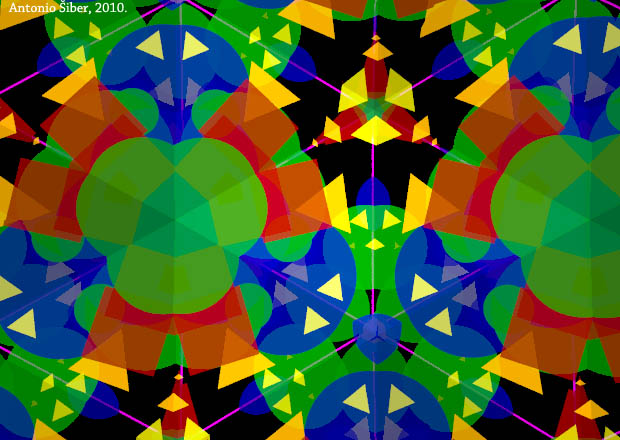
The images above and below were obtained by a "usual" geometry of mirrors in the kaleidoscope. According to the results of experiment I performed, this produces "most pleasant" and "hypnotizing" images. The mirrors are along the sides of equilateral triangle.

The image below was obtained by setting the mirrors on the sides of a square.
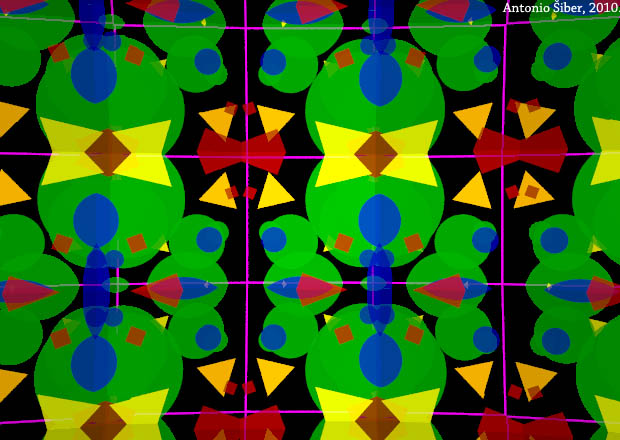
A weirder image is obtained when the mirrors are arranged on the sides of a pentagon.

But the arrangement of mirrors that produces the weirdest and the most unpleasant images is the hexagonal one where the six mirrors are arranged on the sides of a hexagon (see below).

| << Pulsed island | The last whale >> |
Last updated on 26th of January 2010.