Hall of fame: Trifaccia, 3rd of March 2016.

>> Trifaccia was one of the first projects of mine in which I used 3D modeler (Wings3D). Unfortunately, I didn't find models (mask and glass), but the images rendered in PovRay were preserved (above and below).

A good portion of a "fine embroidery" of the image is not in the 3D modeling of the shapes but in the texture programming (the detail below) - note e.g. "crackled gold" of the mask, the mirror frame, two different wood textures and fine, web-like "cracks" on the mirror surface. All these are multilayered textures coded in PovRay (below - can you say something about the floor of the room where the objects are situated?).

In the seven-year-old folder of the project there are also tests of the textures applied to spheres (below - as far as I can see not all textures were used or these may be tests of the early variants).

I experimented with light several times. I tried to get the full visibility of everything in the 3D scene, but also the sensation of light attenuating with the distance. The image below shows one of the early renders in which the light was obviously too intense for my taste as I opted for a darker mood in the later versions (can you note the differences between the three variants shown?).
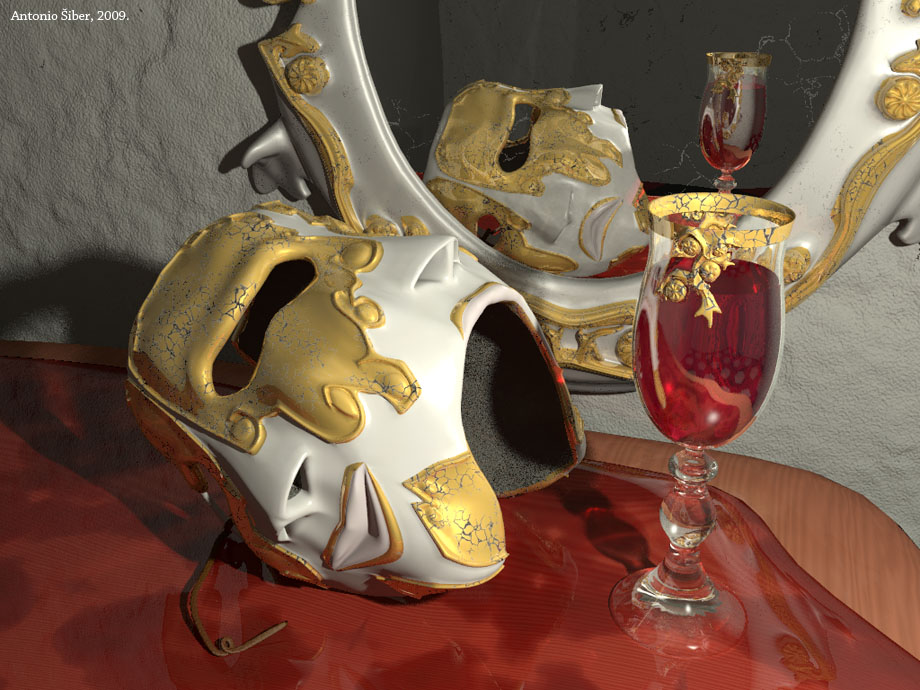
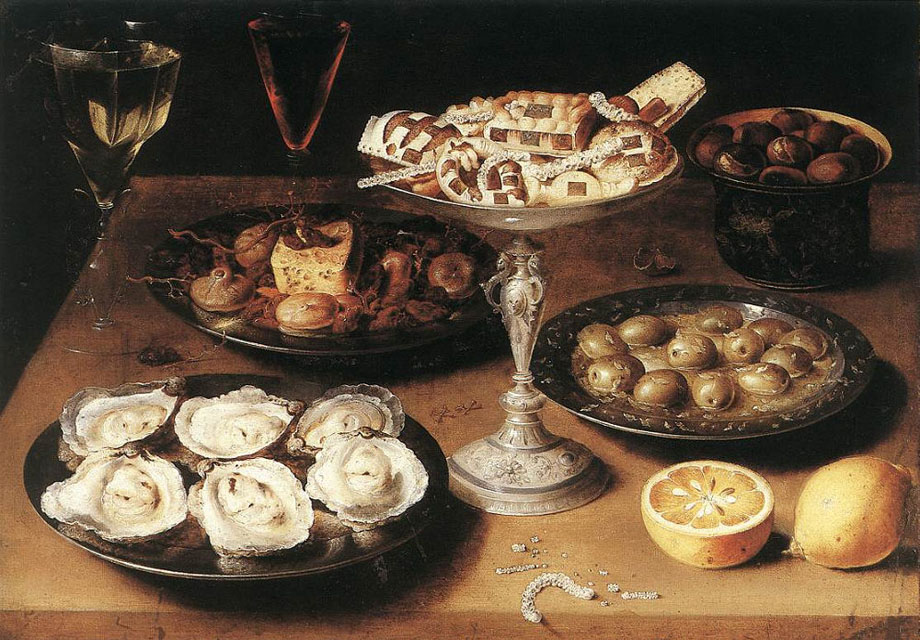
It could be that I looked for inspiration regarding the lighting of the scene in the painting "Oysters" by >> Osias Beert from year 1610 which I also found in the folder (below). On Wikipedia's page on >> Osias Beert on can see that the light which dims rapidly with the distance is quite typical for his paintings (one can also see nicely lit glasses of wine, as in my painting).
In year 2009 I listened to baroque music quite a lot (mostly Vivaldi, Bach and Handel, mostly religious music). It seems that an early version of the image included also
some musical notation (raytracing test of paper with musical notation is shown below), but I obviously abandoned the idea.
Little by little I got interested in baroque from all sorts of aspects and I got to think about it more and more as a "golden age" - I remember I thought of calculus of
variations and a href="https://en.wikipedia.org/wiki/Bernoulli_family"> >> Bernoulli brothers and how even today many have no clue what is it all about and how
centuries passed sometimes make no difference. For those who would like to have a bit more detailed insight in my thoughts, I can recommend reading
>> Wikipedia's paper on brachistochorone curve.

| << Pear | A phone call from a friend >> |
Last updated on 3rd of March 2016.