Juniper, 27th of September 2017.
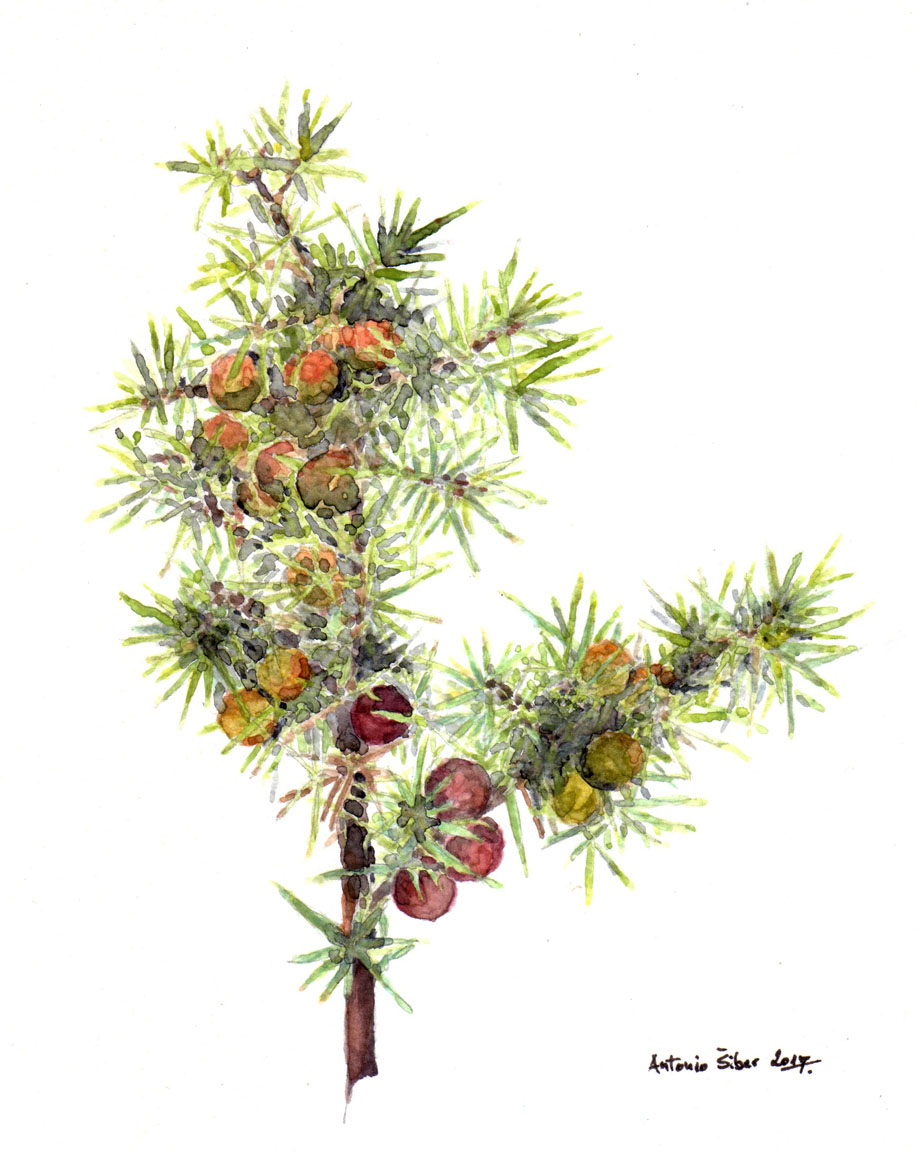
I painted a twig of prickly juniper on Saturday, 23rd of September 2017 on a rock of island of Krk. The weather was for many already completely inadequate for swimming and sunbathing, but
I stayed near the sea for almost the whole day, and I also swam a couple of times. And I painted, of course. I hope that this was not the last time this year - October looks promising :)
The berries were mostly green-yellow with transitions towards orange-brown, and three or four were purple-red. Needle-shaped leaves also come in different colors. Toward the twig ends
they are mostly green-yellow, almost yellow, and closer to the twig origin they are pale, gray-blue-green. My painting, unfortunately, only partially accounts for the colors. I
excuse myself with the fact that I didn't have a palette on the rock, I mixed colors and only a little bit of water on a smooth grey stone.
Prickly juniper or Juniperus oxycedrus L is native to Meditteranean region, but it as a much more famous cousin - common juniper, Juniperus communis. Common juniper has a dark-blue berries
when they are ripe and this is the easiest way to discern it from the prickly juniper.
The illustration below is from the book Flore medicale by Francois-Pierrea Chaumeton, J.L.M. Poiret and J.-B.-J.-A.-C. Tyrbas de Chamberet (1833) and it shows common juniper -
>> click on the image to show it in large resolution.

The illustrator of Flore medicale is Pierre Jean Francoise Turpin (1775 - 1840), a famous French illustrator considered to be one of the best in the Napoleonic era.
Common juniper is also used in cooking. A couple of berries are often added to sauerkraut when cooked. Swiss prepare a sort of a jam (Wacholder Latwerge) from the berry juice
mixed with sugar or honey.
Strong spirits prepared with juniper berries are made throughout ex-Yugoslavia. In Slovenia, they distill the berries, while in Croatia, Bosnia and Hercegovina and Serbia, berries are typically
soaked in the already distilled strong plum spirit (rakija, šljivovica). Sometimes they are added to plums during the fermentation and then distilled together. Much more well-known is, of course, gin, which
is also produced by soaking of juniper berries in the strong spirit.
| << Woodland sage | Abelia >> |
Last updated on 27th of September 2017.